
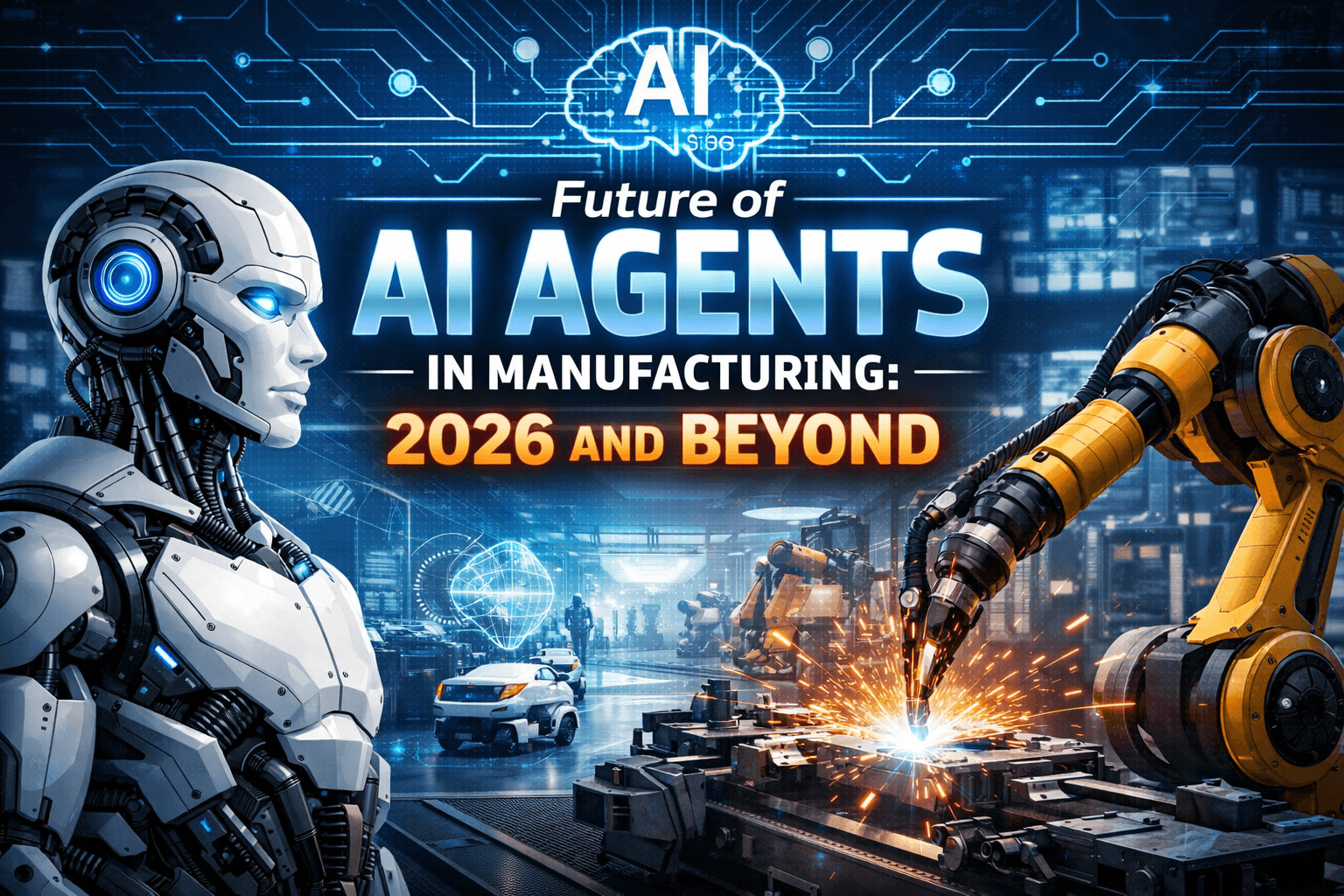
Future of AI Agents in Manufacturing: 2026 and Beyond

Listen to this article
The Agentic Shift: From AI Pilots to Autonomous Operations
Is your factory ready for a workforce that never sleeps? The future of AI agents in manufacturing is rapidly propelling us beyond simple automation, ushering in an exciting era of truly autonomous operations. This isn't just a shift; it's a complete redefinition of industrial capabilities.
Here’s what you'll discover:
- How AI is evolving from basic generative models to powerful, autonomous agents.
- Key areas where AI agents will first transform manufacturing.
- Strategies for integrating AI agents and managing risks.
- The economic implications for early adopters in AI agents manufacturing 2026.
This evolution to agentic AI manufacturing is a fundamental change, moving from systems executing predefined tasks to those that reason, plan, and act independently across complex environments.
Why this shift matters now:
- Evolution from Generative AI to Agentic Infrastructure: AI is progressing from content generation to intelligent systems that perform actions.
- Impact of Global Trade Disruptions on Adoption: Global volatility accelerates the need for resilient, autonomous systems.
This agentic infrastructure empowers manufacturers to navigate unpredictable disruptions with greater agility, fostering operational resilience.
Key Manufacturing Processes for Initial AI Agent Pilots
Identifying the right starting points is crucial for successful AI agent adoption. Initial pilots focus on areas offering clear, measurable benefits and manageable complexity.
Here’s where we’re seeing initial impacts:
- Autonomous Maintenance Scheduling: AI agents continuously monitor machinery health, predicting potential issues before they escalate, ensuring optimal uptime and operational efficiency.
- Predictive Repair Planning and Spare Parts Procurement: By anticipating breakdowns, agents automatically initiate repair protocols and order necessary components, streamlining maintenance workflow.
AI-driven predictive maintenance has already demonstrated significant value, reducing downtime by as much as 40% in manufacturing settings. This offers a compelling case for early adoption.
Autonomous Maintenance Scheduling
AI agents continuously monitor machinery health, predicting potential issues before they escalate. This ensures optimal uptime and operational efficiency.
Predictive Repair Planning and Spare Parts Procurement
By anticipating breakdowns, agents can automatically initiate repair protocols and order necessary components, streamlining the entire maintenance workflow.
Multi-Agent Systems for Factory and Supply Chain Optimization
The true power of autonomous AI manufacturing emerges when multiple agents collaborate. These systems can orchestrate complex operations far beyond what individual AI instances could achieve.
Here’s what matters:
- Coordinating Complex Factory Workflows: Agents collaborate to manage production lines, optimizing resource allocation and scheduling in real-time.
- Real-Time Supplier Contract Renegotiation: AI agents in the AI agents supply chain can identify opportunities and execute favorable contract adjustments instantly.
These multi-agent systems factory solutions enhance efficiency and responsiveness, adapting to dynamic production demands and external market shifts.
Integrating AI Agents with ERP, IoT, and Existing Systems
Seamless integration is absolutely vital for maximizing the value of AI agents within your established industrial ecosystem. They simply *must* communicate effectively with existing enterprise tools.
Here’s how to make it happen:
- Centralizing Service-Ready Data Platforms: Consolidating data from IoT devices and legacy systems provides a unified source, the essential fuel for AI agents.
- Low-Code Platforms for Non-Technical Deployment: These platforms democratize AI agent deployment, enabling wider adoption without deep coding expertise. It’s about empowering more teams.
Industry AI Agents are *already* enhancing ERP functionality, leading to faster issue resolution. This highlights the incredible synergy between new AI capabilities and core business systems.
Human-in-the-Loop Governance and Risk Management
As AI agents gain autonomy, robust governance frameworks are absolutely essential. This isn't just a formality; it ensures responsible deployment and skillfully mitigates potential risks, especially in critical operations where stakes are high.
Here are the critical considerations:
- Safety-Critical Decision Frameworks: Human oversight is mandatory for AI agent actions impacting safety or significant financial outcomes. That human touch is vital.
- Avoiding Project Cancellations Through Controls: Clear value propositions and stringent risk controls are crucial to prevent project abandonment.
Without proper governance, a substantial number of agentic AI projects could face cancellation by 2027 due to unclear value or inadequate risk controls. Let's ensure that doesn't happen!
Workforce Augmentation: Addressing Skills Gaps with AI
Let’s be clear: AI agents aren't here to replace your workforce. Instead, they’re incredibly powerful tools for AI workforce augmentation manufacturing. They can bridge critical skills gaps and give human productivity a massive boost!
So, how does AI supercharge your team?
- Automating Routine Diagnostics: AI tools deliver impressive 20-50% productivity gains in repetitive engineering tasks, freeing up human experts.
- Addressing Structural Job Shortages: Agents can fill roles where human talent is scarce, like the nearly four million jobs facing a structural shortage in manufacturing.
This strategic partnership between humans and AI agents allows skilled workers to focus on higher-value, more creative tasks. Everyone wins!
Scaling Challenges and Strategies for Production Deployment
Pilot projects are fantastic for proving concepts, but let’s be honest: scaling scaling AI agents manufacturing to full production is where the real hurdles appear. Only a small fraction of AI projects truly reach widespread deployment. But don't despair – there's a path forward!
So, how do you beat the odds and scale successfully?
- High-Value Low-Risk Starting Points: For initial large-scale deployments, zero in on areas that offer clear ROI and minimal operational disruption. It’s about smart, strategic moves.
- Building Organizational Muscles for Autonomy: This is key! Develop internal capabilities and processes robust enough to manage and gracefully evolve autonomous systems over time.
Here’s a sobering statistic: only about 5% of generative AI projects actually achieve scale across industries. This really hammers home the importance of a strategic, phased approach to widespread agent adoption. It’s a marathon, not a sprint!
Economic Impact: Early Adopters vs. Laggards in 2026
Get ready for a serious economic shake-up! The divide between early adopters and laggards in AI agents manufacturing 2026 is projected to be absolutely massive. AI agents could add *trillions* in annual value – this isn't pocket change!
What are the big economic drivers here?
- Trillions in Annual Value: Brace yourself: AI agents are predicted to inject an astounding $2.6 to $4.4 trillion in value annually across various sectors. That's a huge piece of the pie!
- Significant Budget Allocation: It's not just talk; 80% of manufacturers are already planning to allocate 20% or more of their improvement budgets specifically to smart manufacturing and data tools. They're putting their money where the future is.
Here’s the bottom line: early adoption of autonomous AI manufacturing isn't just a good idea; it’s going to provide a substantial, undeniable competitive advantage, relentlessly driving efficiency and innovation forward. You don't want to be left behind!
Predictions for AI Agent Adoption and Market Growth
The trajectory for future of AI agents in manufacturing points towards rapid, explosive expansion! Market forecasts and industry surveys confirm a strong, undeniable upward trend. Get ready for takeoff!
Let’s take a quick look at the market:
- Global Market Growth: The global AI agents market is projected to skyrocket to $7.6 billion in 2025, a significant leap from $5.4 billion in 2024. That's serious momentum!
- Widespread Expansion Plans: This is truly remarkable: a staggering 96% of organizations are planning to expand their agentic AI usage in 2026, with 79% already reporting adoption. It’s clear everyone’s getting on board.
Deloitte predicts a fourfold increase in agentic AI adoption in manufacturing by 2026, jumping from 6% to 24%. This rapid growth doesn't just signal change; it heralds a truly transformative period for the entire industry. Exciting times ahead!
So, there you have it! The future of AI agents in manufacturing isn't some far-off dream; it's a rapidly unfolding reality. From optimizing intricate factory workflows to augmenting human capabilities, AI agents are truly poised to fundamentally reshape how goods are produced and supplied. Success hinges on strategic adoption, robust governance, and a clear focus on integration and scaling.
Here are the big ideas to carry forward:
- AI agents are moving manufacturing towards truly autonomous AI manufacturing.
- Early adoption in areas like predictive maintenance offers significant ROI.
- Multi-agent systems factory solutions drive complex optimization and supply chain resilience.
- Human-in-the-loop governance is crucial for managing risks and ensuring successful scaling.
- AI agents will address workforce gaps and significantly augment human productivity.
As manufacturers increasingly allocate budgets to smart technologies, the competitive landscape will undeniably be defined by those who master the art of harnessing AI agents. The coming years won't just see these intelligent systems become useful; they’ll become utterly indispensable, driving unprecedented efficiency and innovation right across the entire industrial sector. Get ready for the revolution!
Never miss another article
Highly curated content, case studies, Magentic updates, and more.